
Hi, it’s me, Steve. Not an AI chatbot. I have in my hand an essay I wrote entitled “Essay about Plants to Be Read at Some Future Event.” Since this show is called Plant, it seemed like a good idea to pull it out and share it with you today. What are the odds? So, here goes:
The word plant is an interesting word. It can be a tricky answer in the game of 20 Questions: animal, vegetable, mineral? Well, yes—all of the above. If you’ve come to a Bad Idea before, you might have thought about the various meanings of the word since the essay portion of the show focuses on that. Or maybe not. But have no fear—I have definitions for you. Thank you, Merriam-Webster.
As a noun, it can mean “a young tree, vine, shrub, or herb” (vegetable), or “the land, buildings, etc. employed in carrying on a business” (mineral), or “an act of planting,” or “something or someone planted” (animal).
As a verb, it can mean “to put or set in the ground for growth,” or “to place firmly or forcibly” (like planting a kiss on a cheek or a hard blow to the chin), or “to covertly place for discovery, publication, or dissemination” (like a corrupt cop planting drugs to frame someone).
Now, if this were a true crime podcast, I could spend the next several minutes talking about cops planting drugs or a terrorist planting a dirty bomb. But instead, I’m going to do something a little less dramatic. I’m going to stick to my lane and talk about metaphorical planting.
The creative process is very plant-like. You plant some seeds of an idea, hope it takes root, and maybe eventually it blooms into something wonderful. Sometimes it feels like one of those houseplants you instantly forget to water or accidentally place too close to the heat vent—and the next thing you notice, you have a sad-looking, wilted creative-process plant. But sometimes it’s like the milkweed seeds you stick in a chopped-up gallon jug and leave outside over the winter until one day in the spring you see little seedlings poking out of the top. I’m sure someone knows how that works, but I’ll just go with “miracle” or “magic.”
Once those ideas take root and start to develop, the work isn’t over. Those plants still need attention. In both sketch comedy and cooking, the idea of pruning is important: cut back to allow things to breathe, trim off the excess. In comedy, sometimes it requires lopping off the best line in a sketch if it doesn’t help move the whole thing forward. It’s a painful cut, but one that makes the whole piece stronger. In designing these menus, I find myself wanting to add another element here, a sauce there, a garnish on top of it all. Pruning back the dish so that it’s not a chaotic mess is the challenge. You don’t want to trim so much that it looks like one of those arborvitae that have been brutalized back to leafless branches. (Side note: I’ve done that multiple times, both in the garden and on the plate.)
One of the things about plants (both actual and metaphorical) is that they tend not to do exactly what we want them to do. The tomatoes in my garden bed have spilled out over the sides, beyond what anyone would clearly know is the edge of the garden. Hello, tomato,boundaries? Or, in the metaphorical sphere, the one-time show turns into a series of seven, eight, nine productions, each seemingly getting more complicated, elaborate, and wonderful.
That’s the thing with this living, organic stuff: it isn’t predictable. And that’s what makes it so exciting. I stick some seeds in the ground and hope I have enough luck and skill that something grows. I try to do a show to bring people together, to feed them, to entertain them, to make them think a little—and I hope I have enough luck and skill that something connects.
And I think this is one of the issues I have with AI: it will only create the spilled-over tomato plant as a failed attempt to make the predictable image of a garden bed. I’m not sure it could have come up with The Bad Idea, or if it did, it wouldn’t be as imperfect as this one is, and the next one will be. (By the way, I asked if it could, and it just told me how wonderful I was to come up with it and that it couldn’t do something so divergent. But did I want help working on the structure, sketches, essays, or recipes? AI is such a brown-noser.)
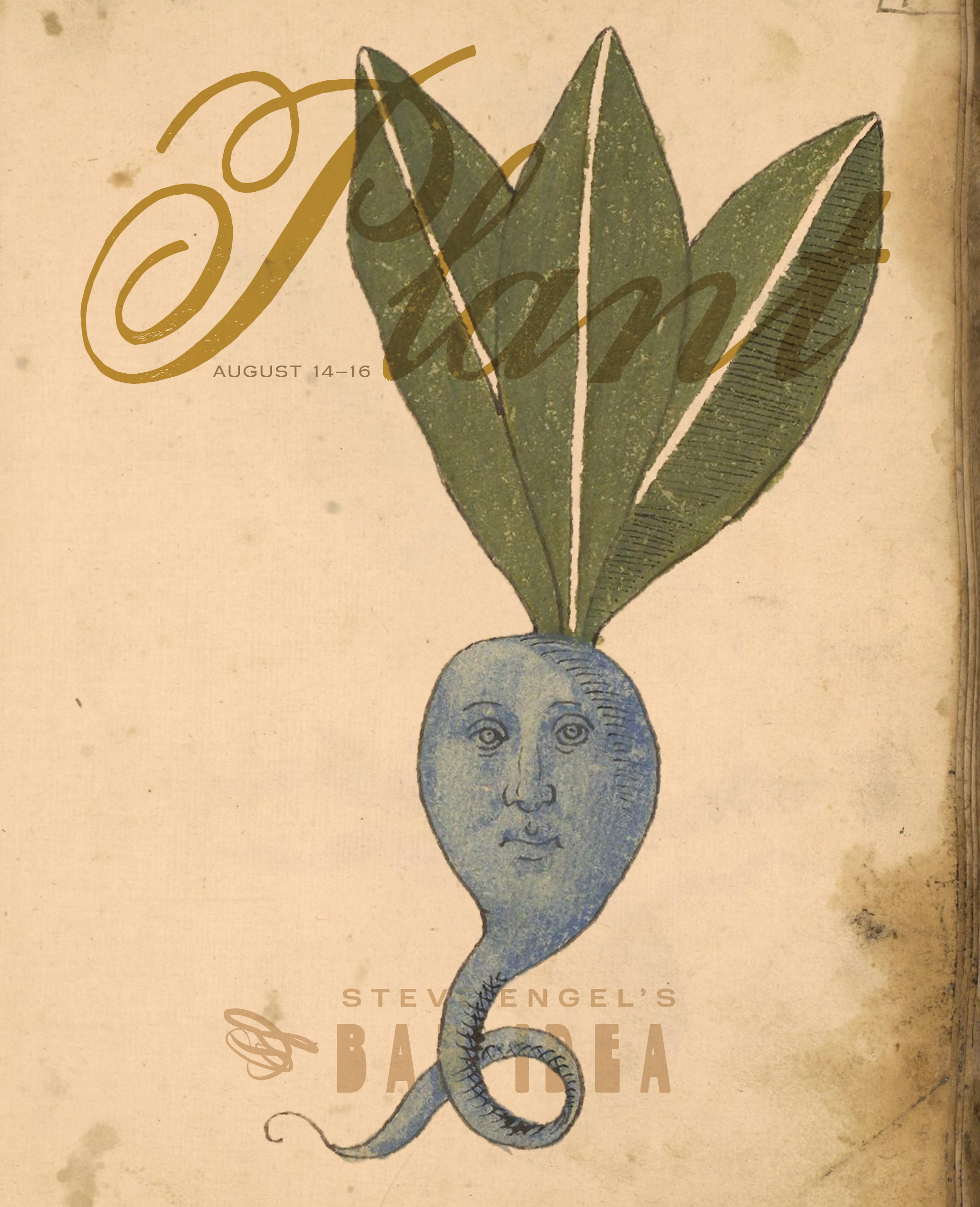
And so, this is where I am: I’ve used AI to animate an old drawing of a turnip, to make Arthur Pretense into a six-fingered chatbot, and to help me turn a bunny into a radical who, according to the program that’s also being used in the Pentagon, is clearly too violent. Seriously, it’s a shadow puppet bunny holding a Molotov cocktail. Are we worried about deepfakes here? But what about the children? Please. Anyway, it was really bad at doing these tasks. It took me multiple attempts. I think the issue is that AI is trying really hard to be useful, but sometimes the things we want to do—the things we need to do—aren’t that useful or efficient or logical. Like this show. Or the tomato plant spilling out of the garden.
And yet, I feel like we need more of these types of plants springing up between the cracks in the pavement.